

How We Raise Our Puppies
Early Development & Socialization
At LakeHaus, every puppy is raised with intentional, science-based protocols to give them the very best start in life. We follow the Puppy Culture program, an internationally respected resource created by Jane Lindquist and trusted by ethical breeders, trainers, and owners around the world. These protocols guide puppies through critical developmental stages—beginning at birth and continuing through the sensitive early weeks—shaping them into confident, resilient, and highly trainable adults. Puppies raised with Puppy Culture consistently show stronger adaptability, reduced risk of behavioral issues, and greater success in both family and working environments.
In addition, we incorporate Early Scent Introduction (ESI) to support olfactory development. Research has shown that ESI can enhance scenting ability, providing a foundation for success in hunting, tracking, and scent detection sports, while also enriching a puppy’s overall sensory experience.
Alongside these developmental protocols, LakeHaus puppies are introduced to early training concepts appropriate for their age. This includes foundations for crate training, routine and impulse control, problem-solving through free shaping, and positive early interactions with handling and daily care. These experiences are designed to support confidence and clarity—not obedience performance—and help puppies transition smoothly into their new homes with a strong learning mindset already in place.
Together, these methods ensure that LakeHaus puppies grow into well-rounded companions—equally prepared to thrive as beloved family pets, dedicated hunting partners, or competitors in performance and conformation venues.
Early Development: Week by Week
From birth through placement, puppies move through predictable developmental stages. Each week brings new neurological, physical, and emotional changes, and our role is to support those stages appropriately — not rush them. Below is an overview of how puppies develop week by week and how we structure their environment during each phase.
Week One
Neurological & Sensory Foundations
-
ENS begins
-
Early scent exposure (ESI)
-
Maternal bonding
Week Two
Awareness & Movement
-
Eyes open
-
Early mobility
-
First de-worming
Week Three
Exploration & Nutrition
-
Sound exposure
-
Novel objects
-
Intro to solid food
Week Four
Confidence & Learning
-
Problem-solving games
-
Crate introduction
-
Clicker foundations
-
Second de-worming
Week Five
Emotional Development & Instinct Introduction
-
Age-appropriate play skills
-
Frustration tolerance
-
Bird introduction
-
Expanding training concepts
Week Six
Curiosity, Environment & Drive Building
-
New people
-
New surfaces
-
Environmental confidence
-
Early retrieve play
-
Third de-worming
Week Seven
Assessment & Preparation
-
Temperament, structure, and drive assessments begin
-
Car rides
-
Closed-crate training
Week Eight
Veterinary Care & Placement
-
First vaccinations
-
Microchipping
-
Final de-worming
-
Placement planning
Early Development Phases
How we guide development from birth through placement.
Puppy development isn’t random — it follows predictable neurological, emotional, and physical stages.
At LakeHaus Kennels, we structure each puppy’s environment to support those stages as they unfold, rather than rushing milestones or applying a one-size-fits-all approach. From early neurological and sensory foundations to confidence building, instinct development, and final evaluations, each phase serves a specific purpose in shaping a stable, capable adult dog.
Below is an overview of the major developmental phases our puppies move through, followed by a detailed, week-by-week breakdown for those who want a closer look.
Phase One
Birth - Week 2

Neurological & Sensory Foundations
This phase focuses on early neurological development and stability. Puppies receive Early Neurological Stimulation (ENS) and Early Scent Introduction (ESI), supporting stress tolerance, sensory development, and resilience. Care during this stage prioritizes calm handling, maternal bonding, and gentle exposure without overstimulation.
Phase Two
Weeks 3 - 4

Exploration & Learning Begins
As senses come online, puppies begin interacting with their environment. We introduce age-appropriate enrichment, sound exposure, novel objects, and early problem-solving experiences. Puppies start transitioning to solid food, begin litter training, and are gently introduced to routine handling and structure.
Phase Three

Phase Four
Weeks 7 - 9

Assessment & Preparation for Placement
Final weeks focus on evaluation and preparation for life beyond the litter. Puppies undergo temperament, structural, and drive assessments to support thoughtful placement decisions. Veterinary care is completed, crate training advances, and puppies are prepared for the transition to their new homes with confidence and stability.
At LakeHaus, our goal is to raise puppies who are not only beautiful representatives of the breed, but also confident, resilient, and eager to learn. We use Puppy Culture protocols, combined with Early Neurological Stimulation (ENS) and Early Scent Introduction (ESI), to provide a structured foundation that interacts with genetics to bring out the best in each puppy.
These protocols do not create “cookie cutter” puppies—every puppy’s natural personality still shines through. Some are bold, others thoughtful, some more independent, and others more people-oriented. What they do provide is an enriched environment that helps create stable, curious puppies who:
-
Bounce back quickly when faced with new or surprising experiences.
-
Learn how to think and problem-solve, making training easier for their future families.
-
Show confidence and affection in their interactions with both people and other dogs.

Raising Confident, Well-Rounded Puppies
Before Birth & the first few days
Whelping Prep
At LakeHaus Kennels, our puppy program begins well before puppies are born. Thoughtful preparation during pregnancy and whelping sets the stage for healthy development during the critical first days of life.
During pregnancy, dams are supported with optimal nutrition, targeted prenatal supplementation, and routine veterinary oversight. Diet is adjusted as pregnancy progresses to support fetal development, maintain maternal condition, and prepare the dam for lactation. As whelping approaches, diagnostic imaging is used to confirm litter count, allowing us to monitor labor accurately and ensure every puppy is accounted for.
A dedicated whelping area is prepared well in advance—quiet, temperature-controlled, sanitary, and familiar to the dam—so she can deliver and bond with her puppies in a calm, secure environment.

Birth & the Neonatal Period (Days 0–2)
The first 48–72 hours are focused on stability, bonding, and careful observation. Puppies remain with their dam, nursing frequently and learning to regulate body temperature, while we closely monitor their overall condition and early development.
During this period, weights are checked and recorded twice daily, with detailed logbooks kept for each puppy to track growth trends, hydration, and vigor. We also document identifying features such as markings and patterning early on, allowing us to follow each puppy’s progress individually from the very beginning.
Handling during these first days is minimal and purposeful, limited to essential care and gentle checks that do not interfere with maternal bonding. The whelping area is monitored continuously, and we remain nearby—often sleeping next to the whelping space—to ensure immediate response if assistance is needed. This close supervision allows us to support both dam and puppies through the critical early transition and ensures that any concerns are addressed promptly.
Early Neonatal Care (Days 3–7)
During this early neonatal window, dew claws are removed and tails are docked in accordance with breed tradition and veterinary guidance. These procedures are performed during the appropriate developmental period, when puppies recover quickly and return immediately to normal nursing and bonding.
Beginning on day three, we introduce Early Neurological Stimulation (ENS)—a series of brief, carefully timed exercises designed to gently activate the developing nervous system during a critical window. ENS supports early stress resilience, neurological development, and adaptability.
Alongside ENS, we begin Early Scent Introduction (ESI), exposing each puppy to a different natural scent daily. This early sensory enrichment supports olfactory development and confidence while laying groundwork for future scent-based work.
The focus of the first week is simple but critical: supporting stability, health, and early neurological development while allowing each puppy to settle, grow, and bond naturally. Everything that follows in our program builds on this foundation.
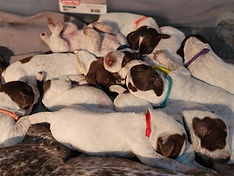
Week One
By the end of the first week, puppies rely heavily on their fully developed sense of smell to locate their dam and navigate their immediate environment. While their eyes remain closed for most of this period—typically beginning to open around day 12–14—their world is already rich with sensory input through scent, touch, and warmth.
This week marks the very early edge of the canine socialization window, which will continue to expand over the coming weeks. Interactions during this stage are subtle but meaningful: nursing, movement within the litter, and gentle contact with their dam and caretakers all contribute to early neurological and emotional development. Our focus during Week One remains on stability, consistency, and allowing natural behaviors to unfold, while continuing close monitoring to ensure each puppy is thriving.
Week Two

Week Two marks the beginning of the transitional phase. Eyes are now open, though vision is still developing, and puppies begin to experiment with standing, balancing, and unsteady movement. While scent remains their primary sense, awareness of their surroundings starts to increase and early independence begins to emerge.
During this stage, routine care expands slightly to include the first scheduled de-worming, which will continue at regular intervals as the puppies grow. Our focus remains on maintaining stability while allowing puppies to explore movement and interaction at their own pace, laying the groundwork for the more active learning that follows in the coming weeks.
Week Three
Week Three marks the beginning of the critical socialization period, when experiences start to carry long-term impact. Puppies become more aware of their environment as hearing develops and mobility improves, leading to increased exploration and interaction with both littermates and their surroundings.
At this stage, we begin introducing daily enrichment through new toys, objects, and surfaces, along with gentle startle-recovery exercises designed to encourage curiosity rather than avoidance. Puppies are exposed to a wide range of sounds—from everyday household noise to music and recordings associated with busy environments such as show rings or fireworks—at volumes appropriate for their age.
Litterbox training is introduced during this week, laying early groundwork for future house training. Carefully selected visitors may also be introduced for brief, positive interactions, allowing puppies to begin forming healthy associations with people outside their immediate household.

Week Four
As puppies gain confidence and mobility, they move into a larger weaning area designed to support exploration and learning. Age-appropriate enrichment is expanded, and puppies begin the gradual transition to solid food while continuing to nurse.
This week introduces more intentional learning experiences, including problem-solving games and early emotional resiliency exercises that encourage curiosity, persistence, and recovery when faced with mild challenges. Puppies are gently introduced to crates as safe, neutral spaces, and clicker training begins with simple foundations such as name recognition, early recall, and polite manding.
Routine care also expands during this stage. Puppies begin regular grooming exposure, including handling, nail trims, and body awareness, all paired with positive associations to support lifelong comfort with husbandry and handling.


By this point, each puppy has begun to show their individual temperament, confidence level, and learning style. From here forward, our focus shifts from general development to refinement, assessment, and placement preparation.
Week Five
At five weeks, puppies enter an important emotional development stage, where confidence-building becomes especially intentional. We carefully support puppies through new experiences while maintaining predictable routines that help them feel secure and capable. Crate routines (meals and rest), problem-solving games, and expanding clicker foundations continue, supporting both independence and engagement. Social play naturally teaches appropriate interaction and self-regulation, while weaning continues gradually as nursing tapers off.
At this stage, we begin allowing carefully selected visitors, ensuring all interactions are positive, calm, and appropriate for developing puppies. Puppies are also introduced to early stacking practice, helping them become comfortable standing still, being handled, and focusing briefly — skills that support future structural assessments and overall confidence. Early bird exposure is introduced for puppies showing interest, always kept positive and pressure-free.

Week Six
This stage is often called the curiosity period, when puppies are especially open to learning and exploring the world around them. We intentionally expand social exposure by introducing puppies to people of all ages and appearances — children, adults, people wearing hats, uniforms, or sporting facial hair — always pairing new interactions with positive experiences. Confidence continues to grow through novel object challenges, varied surfaces, and gentle environmental changes.
This is also the week we host our Puppy Party, inviting approved families and trusted friends to participate in guided exposure and light training exercises. These controlled interactions help puppies generalize their skills and build comfort with new people in a fun, supportive setting. Crate routines continue, veterinary visits are paired with positive reinforcement, and first vaccinations are typically administered at this age. Weather permitting, puppies are introduced to outdoor potty experiences, beginning the transition to appropriate elimination habits.


Week Seven
By week seven, puppies are ready for more intentional preparation for life beyond the litter. This is when we begin formal evaluations, including Volhard and AviDog temperament testing, along with finalizing structural assessments. These tools help us better understand each puppy’s individual traits, strengths, and tendencies, allowing us to make thoughtful placement decisions based on long-term suitability rather than surface preference.
Training and handling continue to focus on prevention-based foundations, helping puppies become comfortable with routine interactions such as people handling food, toys, and chews in a calm, matter-of-fact way. Human socialization expands further, with exposure to a wider variety of people and environments. Crate routines advance to include eating and resting in closed crates, and short car rides are introduced.
During this stage, bird exposure becomes more intentional, always tailored to the individual puppy’s interest and confidence level. Puppies also continue supervised outings in safe settings, building resilience and confidence as they encounter new sights, sounds, and situations.

Weeks Eight & Nine
The final weeks focus on preparation and transition. Puppies complete their first round of vaccinations and are microchipped, and AKC paperwork is finalized. By this stage, puppies are confident in their routines, comfortable with handling, and ready to begin the next phase of development in their new homes.
Each puppy goes home with a LakeHaus Puppy Bug Out Bag, which includes a tote, training guide, blanket, leash, toys, and familiar items to support an easier transition. We spend time preparing families for what to expect during this adjustment period and how to build on the foundations already in place.
While much of the early work has been done here, development does not stop at placement. Families are encouraged to continue structured, positive socialization, introducing their puppy to new experiences regularly as the socialization window continues through approximately 16 weeks. Patience, consistency, and thoughtful exposure during this time help puppies settle confidently into their new environments and continue developing into well-adjusted adult dogs.


The Result
From the very beginning, our focus is not on checking boxes or rushing milestones, but on supporting development as it unfolds. Each experience is intentional, age-appropriate, and guided by what best serves the individual puppy in front of us.
The result is a LakeHaus puppy who enters their new home confident, adaptable, and prepared to continue learning — whether as a family companion, hunting partner, or performance prospect. Our role does not end at placement; we remain a resource for our families for the life of the dog, supporting the transition and the years that follow.
About the Author
Ashley Young is the owner of LakeHaus Kennels (alaskaGSP.com), an Alaska-based breeder of German Shorthaired Pointers focused on health, structure, temperament, and real-world versatility.